

Exhibit Team
Meet the team who brought Campfires & the Embers of Youth to life — historians, storytellers, designers, and community members who pitched in, passed the torch, and keep this history glowing.
Role Call!
Curator: Assistant Curators: Amelia Golcheski, Jason Steinfeld, & Ava Woods
Editors: Amelia Golcheski & Kate Givens
Exhibit Designer: Charles Gandy
Graphic Designer & Digital Exhibit Designer: Exhibit Fabricator: Ken Fisher
Exhibit PHOTOGRAPHER: Courtney Synder
---------------------------------------------------------------------The Cashiers Historical Society gratefully acknowledges
the generous support of the following camps for allowing us access to their archival collections for research, and for loaning objects and artifacts to the museum exhibit in 2025, “Campfires & the Embers of Youth: The History of Summer Camps in Western North Carolina.”Camp Arrowhead • Camp Carolina • Camp Greystone • Camp High Rocks • Camp Merrie-Woode • Camps Mondamin & Green Cove • Camp Sequoyah Collections • Camp Tekoa Collections • Camp Ton-A-Wandah • Falling Creek Camp • Gwynn Valley Camp • Keystone Camp • Rockbrook Camp
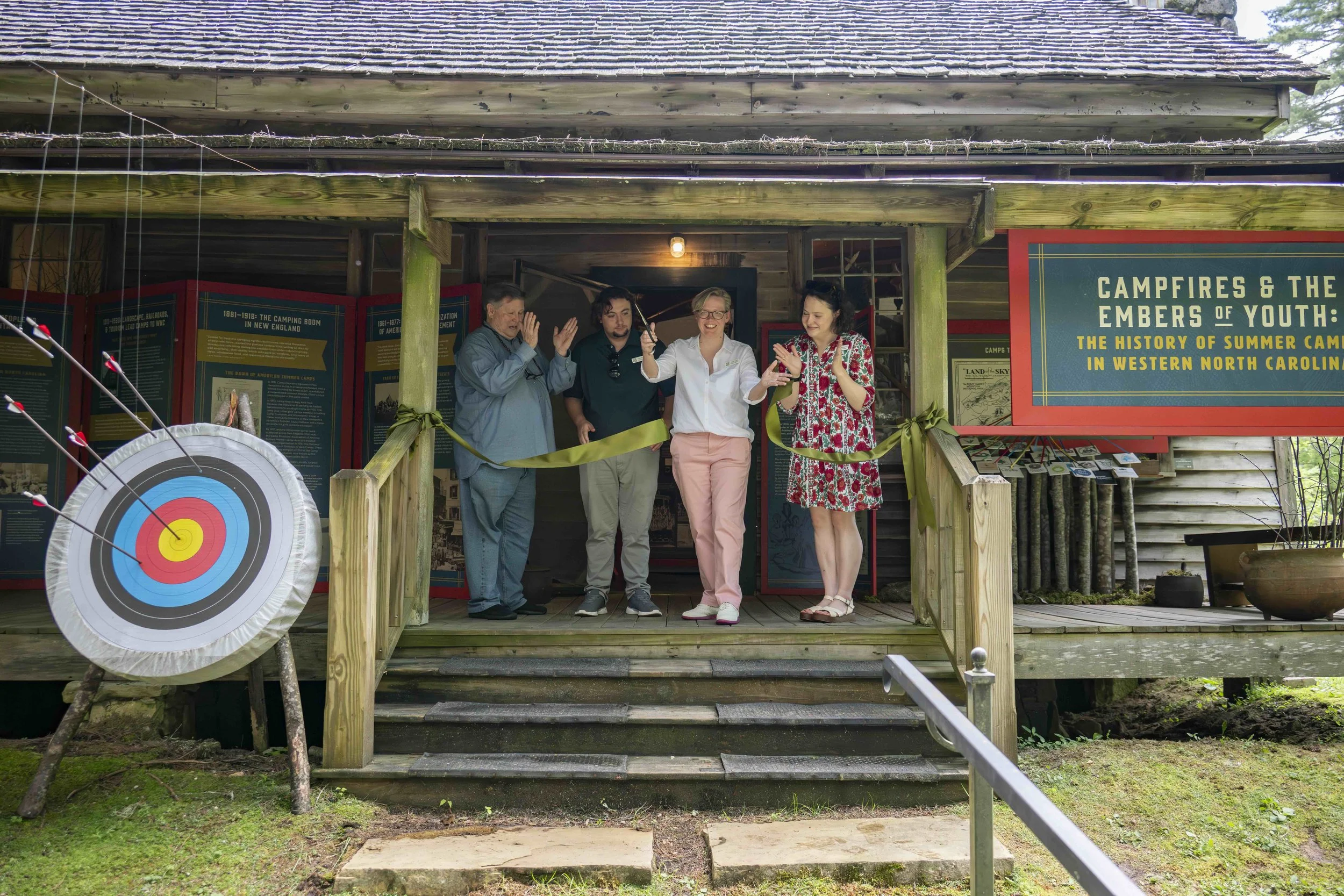
Ribbon cutting event at the exhibit opening, June 2025
Curator’s Statement
BY LINDSAY GARNER HOSTETLER
For over 100 years, summer camps in western North Carolina have fostered worlds for children to grow physically, emotionally, and spiritually. By the 1920s, the region became the center of the American camping movement in the South, influencing the social, economic, and cultural history of the region.
Many former campers consider summer camp as the most formative experience of their youth. I am one of those campers who found refuge, belonging, and self-discovery secluded under a mountain in western North Carolina. Revisiting summer camp through the lens of a historian has been a profound, joyful, and challenging experience.
Existing as small islands, with limited contact with the outside world, summer camps are insular communities, not dissimilar to religious groups, boarding schools, and cults. In this environment, children experience a world that feels freeing, wild, and challenging. Camp directors built communities, removed from campers’ homes and parents, with their own rules, norms, and social structures. Camps embrace their own traditions, language, music, values, and rituals. These types of closed societies have both positive and negative effects on their communities, including a strong preservation of tradition, quick social cohesion, resistance to change, and exclusion and discrimination. This exhibit aims to face all of those layered realities and complicated histories.
In the early 1900s, most summer camps served white Protestant boys from affluent families. Over time, the movement broadened. Camps for girls, immigrants, religious groups, ethnic minorities, and specific populations (such as children with disabilities, cancer, and trans youth) are now found across the country. Since its foundation, the camping movement has been expanding and widening, sometimes quickly and sometimes slowly. The umbrella of summer camp is now large. This exhibit focuses on privately owned, residential camps founded in western North Carolina before 1970 and the experiences most closely connected to “sleepaway camp” for generations of campers since the early 1900s.
The American camping movement is the product of various 19th century social factors, including urbanization, the changing concept of childhood, the birth of child psychology, and a response to the education system of the time. And yet, each generation since has continued to say, “Our children need camp now more than ever before!” Whether it was to escape a world in the chaos of World War II or a world increasingly influenced by screens and the internet, summer camps again and again seem to the the tonic for whatever new challenges face America’s youth. There is a simple yet meaningful solution found in a community created for young people where they gather around the magic of a campfire as the embers of their youth float up amongst the stars before their eyes.
Throughout my research, I returned to many of the words of my own camp’s founder, Dammie Day, a queer, feminist, progressive educator in the 1920s, who sought to create for her campers a radical counterculture to the world, mirroring the one in which she wished she lived:
“We have built campfires together and have felt the common joy of wood-smoke and burning leaves, and we have, around these fires, sung with the stars and believed in the wonder and beauty of life.”
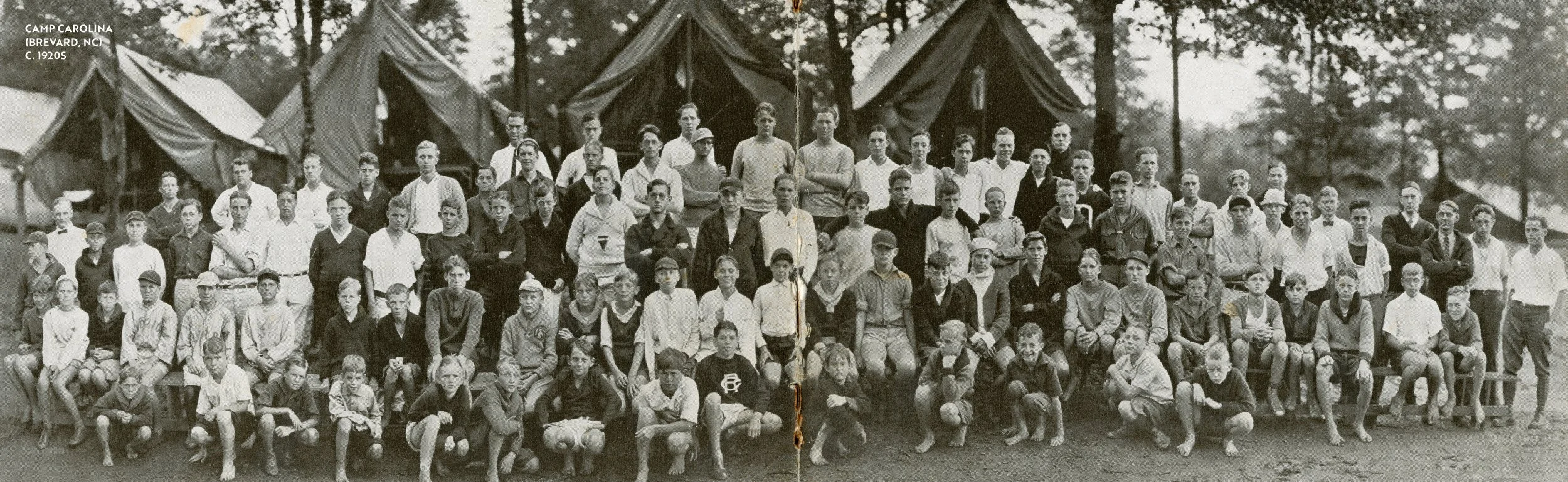
Camp Carolina (Brevard, NC), c. 1920
INSIDE SCOOP ON THE TEAM
-
Lindsay Garner Hostetler is the Director of Operations & Visitor Experience at the Cashiers Historical Society and served as lead curator and researcher for Campfires & the Embers of Youth, which won a design award. With over 15 years of nonprofit leadership experience in western North Carolina — including roles at Mountain Theatre Company and Camp Merrie-Woode — she brings deep regional knowledge and institutional expertise to her work.
At Merrie-Woode, she founded and developed a working archive to preserve, interpret, and share the camp’s historical collections and was instrumental in publishing a book documenting the legacy and enduring significance. Through this process, she discovered a passion for examining the social and cultural impact of the American camping movement.
Hostetler’s scholarly approach blends rigorous research with lived camp experience and personal insight, exploring the charm and complexity of summer camp traditions in WNC — themes she presented at the 2025 Jan Wyatt Symposium.
-
Amelia Golcheski is the Executive Director of the Cashiers Historical Society and served as assistant curator and copy editor for Campfires & the Embers of Youth. A trained public historian, she brings more than a decade of experience in museum education, research, and exhibition development to her leadership at CHS. Her academic work explores the social and cultural forces shaping modern Appalachia, grounding her approach in rigorous scholarship and regional knowledge.
At CHS, Golcheski has overseen publication of two books on Cashiers history — one of which received a design award — organized a symposium on tourism’s impact in the Cashiers Valley, developed a program on southern Appalachian holiday traditions, and curated an exhibit on the High Hampton Inn and Cashiers that also received a design award. In shaping this exhibit, she helped illuminate the layered legacy of summer camps in western North Carolina through historical inquiry and public storytelling.
-
Charles D. Gandy, FASID, is the retired founder and president of Gandy/Peace Inc., a multidisciplinary design firm based in Atlanta. Over a distinguished career, the firm’s residential and commercial work was featured in Architectural Digest, Veranda, Southern Living, and Interiors, earning numerous regional and national honors. Gandy served as National President of the American Society of Interior Designers and received the society’s highest honor, the Designer of Distinction Award. His book Contemporary Classics: Furniture of the Masters received the Joel Polsky Prize for Interior Design Literature. Gandy has designed multiple exhibits at the Cashiers Historical Society.
For his Campfires & the Embers of Youth design, Gandy was inspired by the playful spirit of summer camp. He introduced bold color, energy, movement, elements of the natural world, and immersive storytelling — creating a space that feels alive and resulting in dynamic environments that engage children and adults alike.
-
Lynda Hodge is a Creative Director and Designer with over two decades of experience leading design systems for cultural institutions and heritage-driven organizations. For Campfires & The Embers of Youth, she served as the Museum Exhibit Graphic and Digital Designer, developing the complete visual language — translating archival materials, historical references, and camp artifacts into a cohesive aesthetic experience bridging past and present.
Her design approach balances contextual authenticity with contemporary clarity, drawing on a vintage-inspired style through earth-toned color palettes, organic linework, period typography, and textured finishes rooted in early to mid-20th-century print ephemera. These elements reinforce themes of camp art and evoke memory while guiding curatorial storytelling and visitor wayfinding across physical and digital environments.
Her work emphasizes strategic creative thinking, platform-spanning integration, and narrative cohesion — using design not as decoration, but as an interpretive tool that deepens community engagement, emotional resonance, and regional connection to history and place.
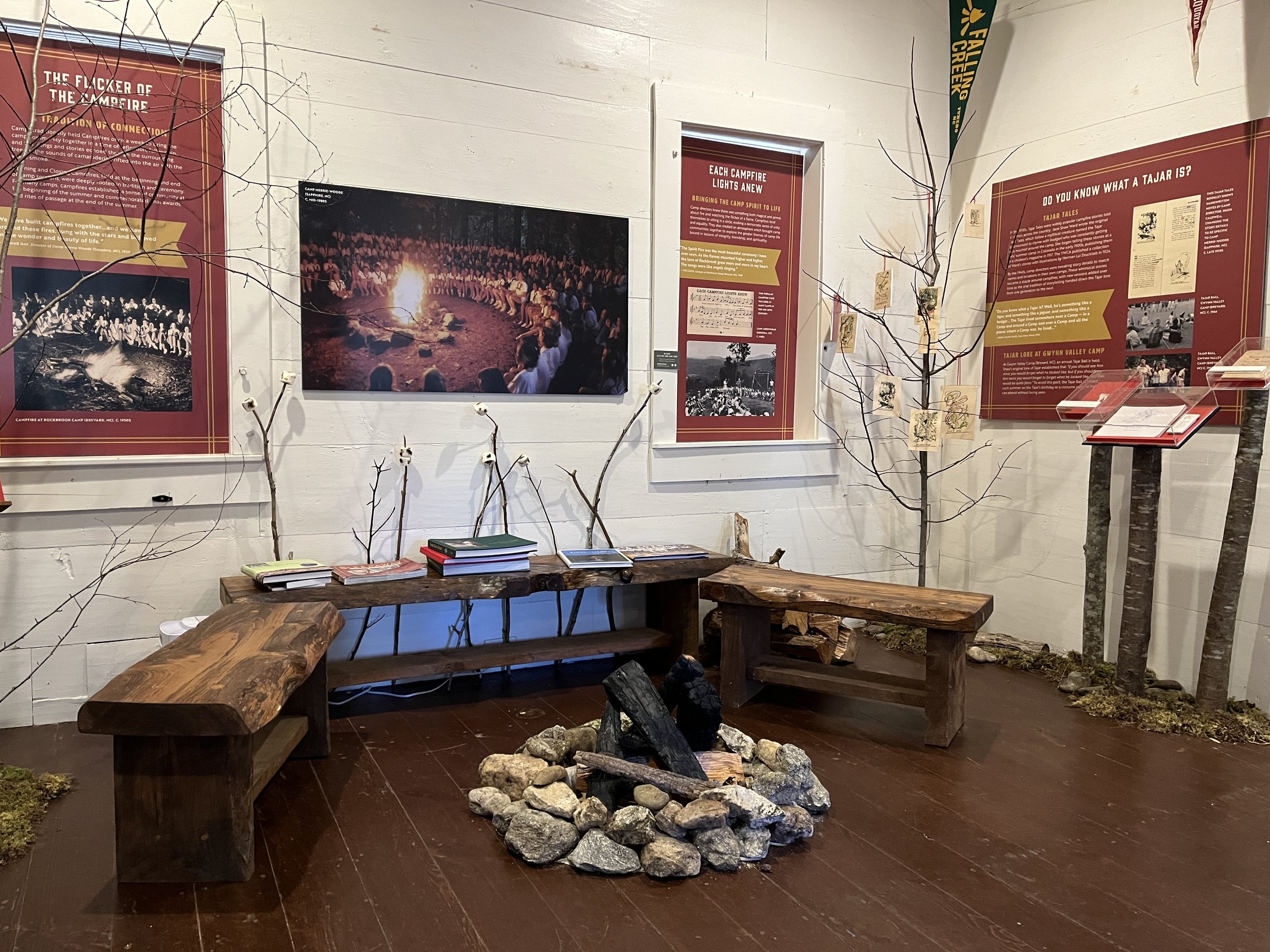
Scene from the museum exhibit
BEYOND THE CAMPFIRE
Discover the full range of programs, lectures, educational initiatives, exhibits, and community events offered by the Cashiers Historical Society.
CHECK OUT THESE OTHER PAGES:
MUSEUM GALLERY + YOUR STORY + ARCHIVAL IMAGES + Bibliography + CAMP SYMPOSIUM + EDUCATIONAL MATERIALS